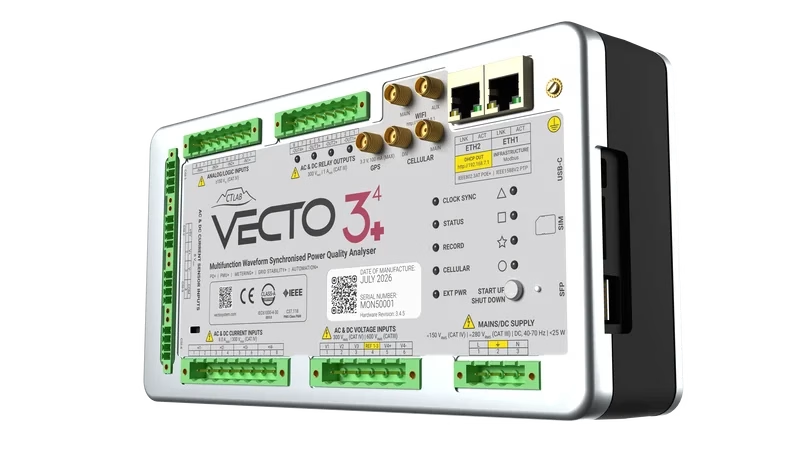
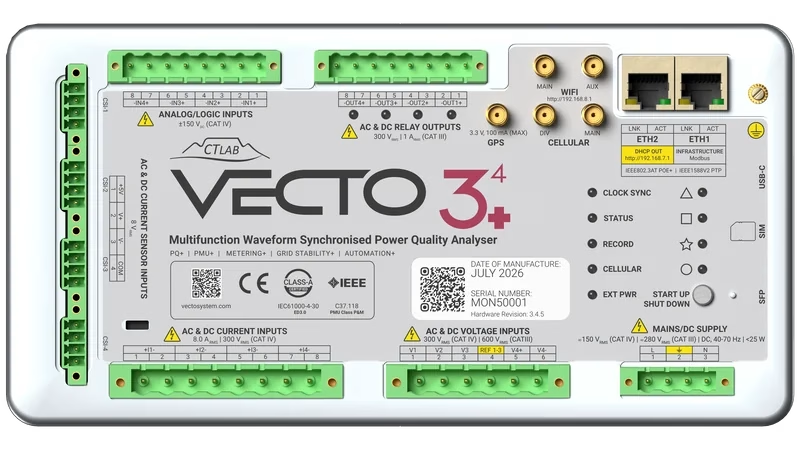
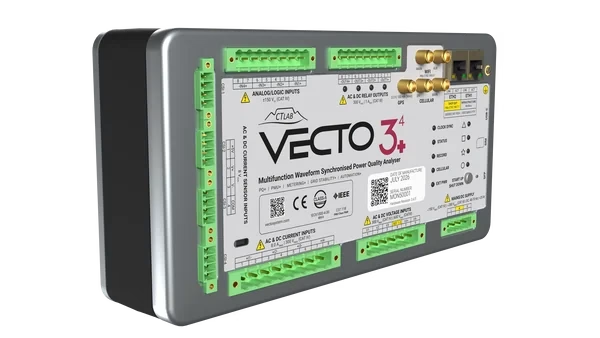
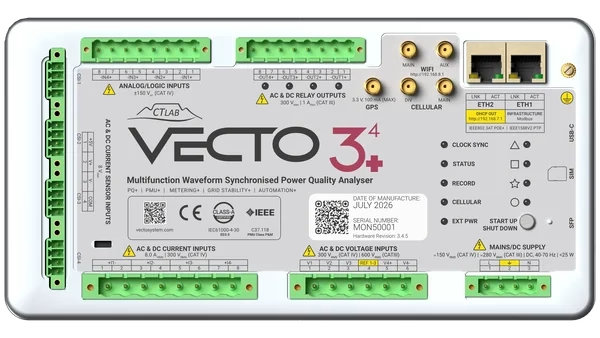
The VECTO 3+ device is identical in functionality compared to the VECTO 3. It contains more than double the processing capacity, 4 times the RAM and a built-in SSD storage device.
It is built to fully support all multi-feeder & multifunction capabilities associated with the new 4-Feeder & IO Expansion Unit. The new 4-Feeder & IO Expansion Unit contains 16 x current sensor inputs, 32 x Analog/Logic inputs and 8 x relay outputs.
Main Functionalities
Ed 4.0 Class-A certified Power Quality
Class P&M PMU recording & Streaming
Sub-Synchronous Oscillation Phasor Monitoring
4-Quadrant Metering
Automation & Control
Modbus
DNP3
IEC61850
Recent Improvements
Analog bandwidth increased >500 kHz to accomodate the 150 kHz higher harmonic requirement currently in the Ed4.0 Annexure
Sampling Rate increased to 2 MHz to further reduce white noise – thus increasing accuracy at the very low end
ADC resolution increased from 16-bit to 18-bit to improve dynamic range and to increase accuracy at the very low end
Dual Band GPS to eliminate signal reflection in built-up areas thus significantly improving PMU small signal accuracy
Dedicated frequency locking hardware to improve dead-reconning and jitter performance associated with poor GPS signal quality
Hardware Features
More than double the processing power & 4 times RAM
Built-in SSD Drive
18-Bit resolution with user programmable gain
2 MHz synchronised sampling rate
>500 kHz analogue bandwidth
50 kHz diagnostic waveform capturing
<100 ns Clock synchronisation (supporting dead reconning) (±10 ns typical)
GPS, IEEE 1588V2 (PTP) & NTP time synchronisation
Battery-backed dual band GPS with active antenna
Battery-backed 4G cellular modem with MIMO antennae
Battery-backed WiFi with MIMO antennae
Battery-backed RTC
2 x Gigabit Ethernet ports with built in DHCP server
Supports fixed and DHCP addressing (IP4 & IP6)
1 x Gigabit SFP fibre port
Lockable USB-C expansion port
2 x Li-Ion cells
Universal AC/DC power supply with very low harmonic content current
IEEE 802.3 compliant POE+
Rugged aluminium enclosure with rubber feet & DIN rail mounts
Comprehensive onboard device telemetry
Fanless
Functional Features
Linux operating system with comprehensive cyber-security support
Encrypted communication with onboard open VPN client
Web server with real-time viewer
Field upgradeable
Rich diagnostic event data streams with long pre- & post data
Synchronised diagnostic waveform data sampled at fixed 50 kHz sampling rate
Xross Trigger® mechanism – (synchronous cross-triggering of multiple devices)
Measures AC & DC parameters
Offline synchrophasor recording
Per Cycle SCADA parameter update speed
Supports 16.66 Hz, 50 Hz, 60 Hz & 400 Hz networks
Harmonic powers & phase
Prevailing phasors
Prevailing harmonic magnitude ratio
Higher harmonic bands (up to 25 kHz)
Frequency lock on chopped voltage waveforms
Calculate 3rd or 4th current from existing 2- or 3-current inputs
Compensate harmonic amplitude & phase angle of external sensors
Simultaneously record various time interval data streams
VECTO 3+ Interfaces
Device Compliance
Power Quality Instrument: IEC 62586-1 – PQI-A-FI1-H
Power Quality: IEC 61000-4-30 ED 4.0 Class-A
Harmonics: IEC 61000-4-7 Class 1
Flicker: IEC 61000-4-15 Class F1
PMU: IEEE C37-118 Class P&M
Billing: IEC 62053-22 Class 0.2S
External Interfaces
4 x High impedance voltage inputs with selectable measurement range 4 x Galvanically isolated current inputs 4 x Current sensor inputs with selectable measurement range (5 V Powered) 4 x Analogue/logic event inputs 4 x Solid-state relay outputs w LED Indicators 1 x Universal AC/DC power supply input 2 x Gigabit Ethernet ports with POE & PTP support 1 x 1000BASE-X SFP cage 2 x WiFi antenna ports (MAIN, AUX) 2 x Cellular antenna ports (MAIN, DIV) 1 x SIM slot 1 x Active GPS antenna port 1 x USB-C expansion port (lockable) 13 x LEDs 1 x Power on/off push button 1 x Safety earth connection point 1 x Kensington key slot
Product Functionality
PQI: IEC 61000-4-30 Ed 4.0 Class-A
PMU: IEEE C37-118 Class P&M
oPMU: Sub Synchronous Oscillation phasor measurement
Automation protocols supported
Modbus
DNP3
IEC 61850
IEEE C37-118 – Simultaneous Class M & Class P (PMU Streaming)
Metering features
Imported
Exported
Net
Month to date Modbus register
Previous month Modbus register
Voltage Inputs specifications of the VECTO 3+
Voltage inputs
Number of channels
4 x voltage inputs (3/4 Wire + 4th Diff)
Measurement input range
0-600 VRMS (VLN), 0-1,000 VRMS (VLL)
Voltage measurement
Single Phase, 3-Phase (Star, Delta), DC
Input impedance/channel
> 1 MΩ
Direct Current inputs specifications of the VECTO 3+
Direct Current inputs
Number of channels
4 x galvanically isolated inputs
VA burden @5 A
< 125 mVA
Measurement input range
0-8.0 ARMS
Max continuous current
10.0 ARMS
1 s over-current withstand
50 A
Galvanic isolation
1,000 V
Current Sensor inputs specifications of the VECTO 3+
Current Sensor inputs
Number of channels
4 x differential low voltage inputs
Measurement Input Range
8.5 VRMS, ±12 VDC
Input impedance/channel
>1 MΩ
Power specifications of the VECTO 3+
Power
Power consumption
< 25 W
AC/DC supply voltage
90-280 VAC (40-70 Hz), 90-300 VDC
Power over Ethernet
IEEE 802.3at compliant
Onboard battery
Li-ION (>2,000 charge/discharge cycles)
Analog/Logic inputs specifications of the VECTO 3+
Analog/Logic inputs
Number of channels
4 x Analog/Logic inputs
Input Voltage rating
± 300 VDC
Resolution
16-Bit
Relay output specifications of the VECTO 3+
Relay outputs
Number of channels
4 x galvanically isolated solid-state relays
Switch rating
1 ARMS, 300 VRMS (max)
Galvanic isolation
1,000 V
Table showing the accuracy & bandwidth specifications of the VECTO 3+
Accuracy & Bandwidth
Sampling rate
2.0 MHz (time synchronised)
Analogue bandwidth
>500 kHz
Waveform storage rate
1 kHz – 50 kHz (user configurable)
ADC resolution
>18-bit
Overall accuracy
<0.1%
Fast transient capturing
≥ 20 μs
Power frequency range
DC, 40-70 Hz, 400 Hz
Harmonic spectrum
1-64th (harmonic and inter-harmonic)
Higher harmonic bands
DC – 25 kHz (200 Hz bands)
Physical specifications of the VECTO 3+
Physical
Construction
Aluminium, 250 x 135 x 65 (L x W x H)
Weight
1.9 kg
Mounting options
3U-19” Rack, Panel Mount, Portable Case
Electrical connections
Pluggable screw type (screw lock-down)
Operating temperature
-25 °C to +55 °C
Storage temperature
-25 °C to +70 °C
Operating humidity
0-95%(non-condensing)
Communication specifications of the VECTO 3+
Communication
Ethernet
2 x Gigabit Ethernet with PTP & POE support
Fibre
1 x 1000BASE-X SFP cage
Cellular modem
1 x Battery backed industrial 4G module
Cellular antennae
2 x Cellular antenna ports (MAIN, DIV)
Wifi
1 x industrial WiFi module
Wifi antennae
2 x WiFi antenna ports (MAIN, AUX)
Operating modes
Access Point or Infrastructure Mode
USB expansion port
USB-C port – 480 Mbit (5 V powered)
Clock specifications of the VECTO 3+
Clocks
Precision time source
Dual Band GPS & IEEE 1588 (V2.0) PTP
Clock sync accuracy
<100 ns from absolute time
Onboard fall-back time source
Battery Backed Real Time Clock
On-Board RTC drift
10 ppm (320 seconds per annum)
Other sources
NTP
Next generation power grid management
Download the VECTO 3+ specification sheet.
Frequently Asked Questions
VECTO 3 Interface FAQs
What is the functionality of the AC & DC Voltage Inputs?
The VECTO 3 is equipped with 4 x high-impedance broadband AC & DC voltage inputs. The first three inputs share a common reference whil the 4th channel is fully differential.
The following topologies are supported:
Single Phase
3-Phase Star
3-Phase Delta
What is the functionality of the AC & DC Current Inputs?
The VECTO 3 features 4 x broadband galvanically isolated AC & DC current inputs. The input burden of each channel is very low (±5 mΩ). Current inputs are designed to be used with external 1 A / 5 A CTs. VECTO devices support configuration of CT ratios and can derive the “missing” current from 3-or 4-wire networks.
What is the functionality of the AC & DC Current Sensor Inputs?
The VECTO 3 includes four broadband current sensor (low voltage output current sensor) inputs, for interfacing with sensors such as split-core CTs, Hall-effect transducers , Rogowski coil sensors, and precision shunt modules.
Core Functionality
Channels: 4 fully differential input pairs
Signal Type: Instantaneous broadband AC & DC voltage signals representing current
Typical Sensor Types:
Low Voltage output Split-core or clamp-on current sensors
Power Supply to Sensors: A common GND referred 5 V power source supplies power to each sensor channel (1 W max), simplifying installation of active sensors
Application Scenarios
Renewables & Storage: Accurate current monitoring of inverter outputs, battery strings, and DC buses using Hall-effect sensors
Retrofits & Isolation: Split core CTs enables measurement without interrupting high-current circuits, ideal for sites lacking safe CT access
Wide Dynamic Range: Captures low-current signal integrity in monitoring & control systems and high-current surges in protection circuits
Complement to CT Inputs
These inputs complement the galvanically isolated current inputs by offering precision low-voltage interfacing where direct current wiring is not feasible or desirable.
The user may configure 3 x current inputs AND 1 x current sensor input to make a full 4-channel current measurement.
Please Note: Towards end of 2026, VECTO Devices will be able to support multiple current feeders. On its own it will concurrently support both current and current sensor inputs (2 x sets of 4-channel current inputs). When complemented by a 4-Feeder & IO Expansion Unit, VECTO 3 devices will support direct measurement of up to 6 x 4-channel current feeders (20 x current channels).
What is the functionality of the DC Analog/Logic Inputs?
The VECTO 3.4 provides 4 x differential bi-polar DC analog/logic inputs. The VECTO 3 can record a trend of the analog signals applied, and it can record an event when any one of the analog values exceeds a logical threshold.
Their typical uses include:
Trend analog input signals.
Triggering recordings or diagnostics based on logic level changes (e.g., detecting breaker trips).
Synchronising external control or protection system events with waveform and PQ data.
Capturing time-aligned status changes in automation or fault analysis scenarios.
These inputs can be configured through the VECTO HMI interface or remotely via VECTO Grid OS or Osprey Lite (bundeled support software).
What is the functionality of the Relay Outputs?
The VECTO 3 includes 4 x galvanically isolated solid-state relay outputs. Each relay output has an on-board LED status indicator. The relays can be controlled externally via various SCADA interfaces. Relays can also be controlled by any internal PQ or other related event. The first relay is dedicated to indicate device health. This relay will be energised when the device is powered, configured and recording data.
What is the functionality of the Network Interfaces?
The VECTO 3 is equipped with robust and redundant network interfaces to support high-availability communications in utility, substation, and enterprise environments.
Here’s a breakdown of their functionality:
Ethernet Ports (2x Gigabit)
Port 1: Typically used for corporate or SCADA network connections.
Port 2: Often reserved for direct laptop access (e.g., commissioning or diagnostics).
Functions:
Supports POE+ (IEEE 802.3 compliant) for power delivery and network communication through a single cable.
Provides PTP (IEEE 1588v2) time synchronization capabilities.
SFP Port (1x Gigabit Fiber)
A 1000BASE-X SFP cage for fiber-based uplinks.
Ideal for EMC-sensitive environments or long-distance, electrically isolated data links.
Wi-Fi Interface
Battery-backed Wi-Fi module with MIMO antenna support.
Allows local wireless connectivity for setup, monitoring, or bridging data where cabling is impractical.
4G Cellular Modem
Includes a SIM card slot and external antenna ports.
Offers redundant mobile data access for remote sites without fixed connectivity.
Compatible with public and private APNs; supports both static and dynamic IP addressing.
Security & Protocols
Supports OpenVPN, SSH, HTTPS, and SCADA protocols like Modbus TCP, DNP3, and IEC 61850.
Data channels secured with encryption and password protection.
Redundant failover paths for critical infrastructure.
The networking capabilities of the VECTO 3 make it a powerful edge device for modern, digital substations and smart grid applications.
VECTO 3 Features FAQs
What is IEC 61000-4-30 Class-A compliance?
IEC 61000-4-30 Class-A is the highest accuracy classification for power quality measurement instruments. Class-A devices meet strict requirements for measurement uncertainty, time synchronization, and aggregation methods.
VECTO 3 is IEC 61000-4-30 Class-A compliant, making it suitable for contractual applications, compliance verification, and dispute resolution where the highest measurement accuracy is required.
What is waveform synchronization?
Waveform synchronization uses precicion time sources like GPS or PTP to timestamp each sampled value with sub-microsecond accuracy. This enable direct comparisson/calculation of data measured on different devices at different locations to obtain new wide area parameters.
What is Sub-Synchronous Oscillation Phasors?
Sub-synchronous oscillation (SSO) phasors represent the magnitude and phase angle of electrical voltage or current components oscillating at frequencies below the normal grid operating frequency (such as 50 Hz or 60 Hz). Measured by advanced monitoring devices like Phasor Measurement Units (PMUs), these sub-synchronous phasor components help detect hidden resonance, mechanical shaft stress, and inverter control instability in modern power grids.
VECTO 3 devices can accurately measure the amplitude, phase angle and frequency of up to 3 x dominant sub-synchronous oscillation phasors on 3 x different frequency bands.
What is a Phasor Measurement Unit (PMU)?
A Phasor Measurement Unit (PMU) is a device that measures electrical phasor quantities (voltage magnitude, current magnitude, and phase angle) with GPS synchronization for real-time grid monitoring. PMUs provide sub-second measurements at 30-120 samples per second, enabling grid operators to detect and respond to power system disturbances in real-time. VECTO 3 includes PMU+ capabilities compliant with IEEE C37.118 standards Class P&M simultaneously.
What is edge computing in VECTO 3?
VECTO 3 firmware is Linux based and the device offers spare processing & storage capacity that can be exploited for future features & functionality. At the edge of network – on the device itself, measured data is at its highest definition. Our aim is to process as much data on the device itself as possible – enabling users a rich set of compressed information via SCADA interfaces with a very high update speed. Our aim is also to enrich retrieved data to reduce the amount of data to be transferred. But at the same time, we will give the user full access to broadband waveform information when required.
What is the difference between PMU streaming and SCADA?
PMU streaming broadcast synchrophasor data typically once per cycle to a remote network endpoint. Synchrophasor data are typically used for real-time control of the network. However synchrophasor data is also frequently used to investigate network stability, damping etc.
SCADA data is typically requested from a device via protocols like Modbus, DNP3 & IEC61850. SCADA data can be concise and fast or comprehensive and slower and has a wide variaty of applications.
Modern protocols Like IEC61850 can contain different classes like Sampled values, MMS oor Goose.
What communication protocols does VECTO 3 support?
VECTO 3 supports Modbus IP, FTP and a few other industry standard protocols by default. The device can be configured & data downloaded in PQDIF and other formats without a single piece of proprietry code. IEC 61850, DNP3 & IEEE C37.118 streaming protocols requires additional licencing.
Can VECTO 3 monitor renewable energy integration?
The VECTO 3 is specifically designed for monitoring renewable energy integration challenges. The device monitors power quality impacts from inverter-based resources (IBR), detects sub-synchronous control interactions from solar and wind farms, verifies grid code compliance, and tracks frequency response from renewable generators. The combination of PMU+, Power Quality+, and Grid Stability+ capabilities provides comprehensive monitoring for renewable-heavy grids.
What is the harmonic/interharmonic capabilities of the VECTO 3?
VECTO 3 devices are harmonic analysis devices par excellence. Their 2 MHz oversampling, 18-bit resolution combined with user programmable gain optimise the effective use of ADC range and reduces white noise completely – maximising low end harmonic resolution and accuracy.
The following Harmonic/Interharmonic functionalities are supported:
Hourly & Daily 95%, 99% 3-sec CPF harmonic values
Harmonic & Interharmonics (DC-64th) – Including all individual harmonic power and phase angle parameters – enabling accurate emission measurement.
Harmonic THD (up to 50th)
Prevailing Harmonic Phasors
Higher Harmonics (up to 25 kHz)
Harmonics are certified according to IEC 61000-4-7 Class I.
VECTO devices can operate stand-alone or as part of a fleet of permanently connected devices managed by VECTO Grid OS, the big data hosting, visualisation, analysis & reporting software platform.